INDIA
INDIA USA
USA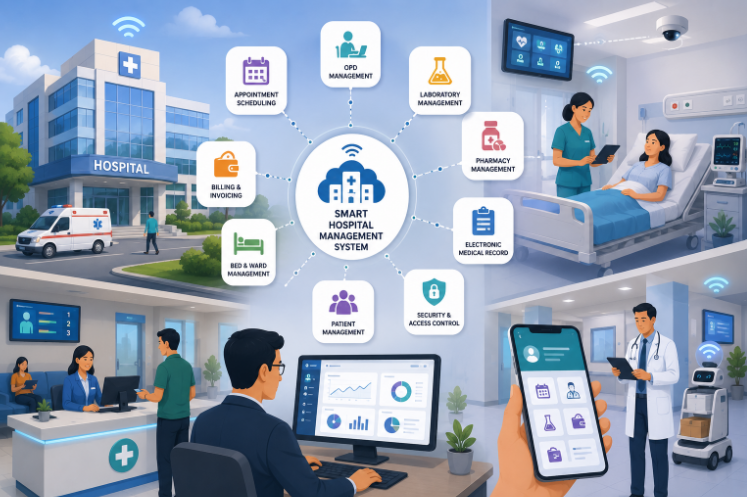
Smart Hospital Management System Supporting Advanced Healthcare
Healthcare delivery in India is changing faster than ever, and technology is at the center of that shift. A smart hospital management system is no longer a futuristic idea reserved for large corporate chains - it has become a practical necessity for hospitals of every size that want to reduce errors, save time, and improve patient outcomes. From automated workflows to connected devices that talk to each other in real time, smart systems are redefining what efficient healthcare looks like across the country.
What Is a Smart Hospital Management System?
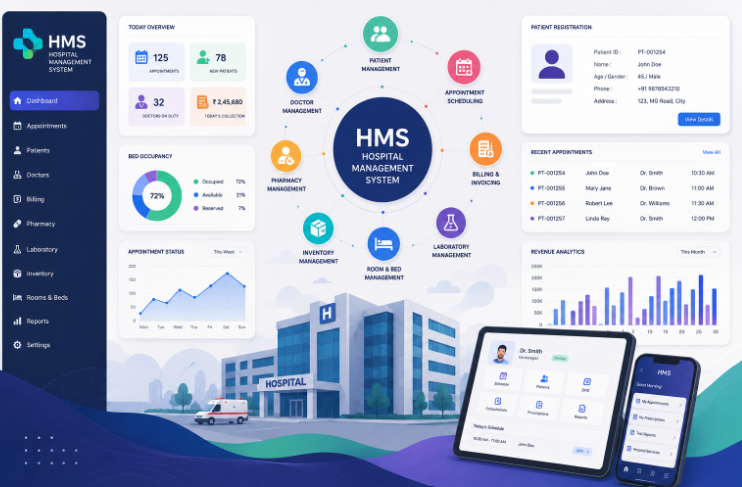
At its core, a smart hospital management system is a digital platform that connects every operational and clinical function of a hospital - patient records, staff scheduling, diagnostics, communication, and resource tracking - into one unified environment. Unlike older, siloed software where each department worked in isolation, a smart system allows information to move instantly between teams.
This means a lab result generated in one wing can immediately update a doctor's dashboard, a nurse can be alerted the moment a patient's vitals cross a safe threshold, and administrators can see occupancy or resource usage without walking floor to floor. It's not just software running in the background; it's an intelligent layer that actively supports decision-making across the hospital.
Traditional Hospitals vs Smart Hospitals: What's Changing
The gap between conventional hospital operations and smart, connected ones is becoming harder to ignore. A few key differences stand out:
This shift isn't about replacing human judgment; it's about giving doctors, nurses, and administrators better information faster, so they can focus on care instead of paperwork.
The Role of IoT in Smart Hospitals
Internet of Things (IoT) devices are quietly becoming one of the biggest contributors to smarter healthcare. Connected monitors, smart beds, wearable trackers, and even temperature-sensitive storage units for medicines are now capable of sending live data directly into a hospital's central system.
For example, a patient's heart rate or oxygen levels can be tracked continuously and flagged automatically if something looks abnormal, instead of waiting for a scheduled check. IoT-enabled equipment tracking also helps hospitals know exactly where a ventilator, wheelchair, or infusion pump is at any given moment - something that used to eat up valuable staff time in larger facilities.
AI and Automation Powering Modern Healthcare
Artificial intelligence is playing a growing role in how hospitals operate day to day. From automatically flagging abnormal scan results to scheduling staff shifts based on patient load, AI helps reduce the manual workload that often slows hospitals down.
Automation, closely tied to AI, is what makes routine tasks - appointment reminders, billing calculations, inventory reordering - run in the background without constant human intervention. This is exactly where a well-built hospital management software becomes valuable: it acts as the foundation that ties AI tools, automation rules, and daily hospital operations together into one working system, rather than leaving each function to run separately.
Real-Time Data and Predictive Analytics in Healthcare
One of the most powerful advantages of a connected hospital system is access to real-time data. Instead of relying on end-of-day reports, administrators and doctors can see what's happening as it happens - current bed occupancy, ongoing procedures, pending lab results, or staff availability.
Predictive analytics takes this a step further. By analyzing historical patient data and current trends, hospitals can anticipate patient surges during certain seasons, predict which patients are at higher risk of readmission, and plan staffing or inventory accordingly. This shifts hospital management from a reactive process to a proactive one, which ultimately saves both time and cost while improving patient safety.
Interoperability: Connecting Every Department
A smart hospital is only as effective as its ability to connect different departments seamlessly. Interoperability means that OPD scheduling, IPD bed management, billing, and inventory don't function as separate islands - they exchange data automatically, so information entered once doesn't need to be re-entered elsewhere.
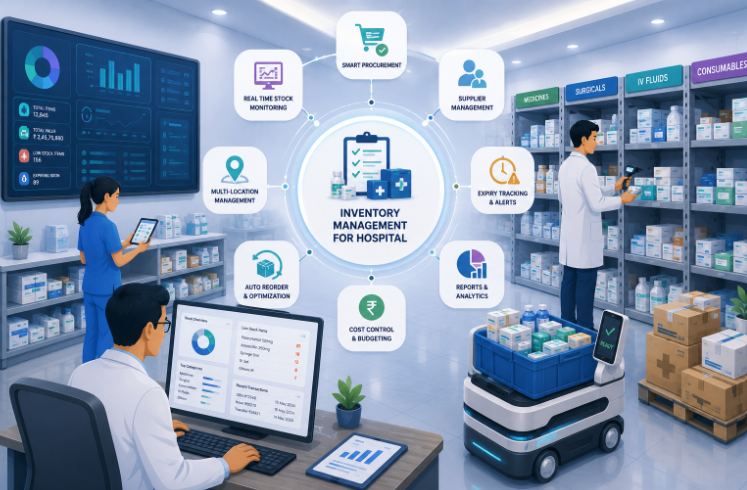
For instance, when a patient moves from OPD to IPD, their history, prescriptions, and billing details should carry over without manual duplication. Similarly, inventory and billing systems staying in sync ensures that medicine usage during a patient's stay reflects accurately in the final bill, without back-and-forth between departments. This connected approach is central to how a modern hospital management software is expected to function.
Enhancing Patient Experience Through Technology
Patients today expect the same convenience from hospitals that they get from other digital services. Online appointment booking, SMS or app-based reminders, digital prescriptions, and easy access to reports all contribute to a smoother experience.
Beyond convenience, smart systems also reduce waiting times significantly. Real-time queue updates, faster diagnostic turnaround through connected lab systems, and quicker billing processes mean patients spend less time waiting and more time actually being cared for. For hospitals, this translates directly into better patient satisfaction scores and stronger word-of-mouth reputation - both of which matter enormously in India's competitive healthcare market.
The Future of Smart Hospitals in India
India's healthcare sector is moving steadily toward digital adoption, driven by both government initiatives around digital health records and growing patient expectations for faster, more transparent care. Tier 2 and tier 3 city hospitals, which were traditionally slower to adopt technology, are now increasingly investing in smart systems to stay competitive with larger urban facilities.
As 5G connectivity expands and cloud infrastructure becomes more affordable, the smart hospital management system of the near future will likely include even deeper AI-driven diagnostics, wider use of wearable health monitoring, and tighter integration between hospitals, diagnostic labs, and pharmacies. Hospitals that adopt these systems early will be better positioned to handle growing patient volumes without compromising on care quality.
FAQs
What is the main benefit of a smart hospital management system?
The biggest benefit is connected, real-time visibility across departments - doctors, nurses, and administrators all work with the same updated information instead of relying on delayed reports or manual coordination.
How is a smart hospital different from a regular digital hospital system?
A regular digital system might digitize records, but a smart hospital management system goes further by connecting devices, automating routine tasks, and using data actively for predictions and alerts rather than just storage.
Is IoT necessary for a hospital to be considered "smart"?
Not strictly necessary, but it significantly enhances the experience. Common IoT use cases include:
Are smart hospital systems suitable for small and mid-sized hospitals in India?
Yes. Many platforms are now built to scale, meaning smaller hospitals can adopt core features first - like connected OPD/IPD workflows and automated billing - and expand as their needs grow, without a complete infrastructure overhaul.
Related reading: What Is a Hospital Information System (HIS)? Full Form, Modules and Benefits
Conclusion
The move toward a smart hospital management system isn't just a technology upgrade - it's a shift in how hospitals think about patient care, efficiency, and long-term growth. With IoT, AI, automation, and real-time data working together, hospitals across India are becoming better equipped to handle rising patient expectations while reducing operational strain on their staff. As adoption grows, the hospitals that invest in these connected systems today will be the ones setting the standard for advanced healthcare tomorrow.
Ready to Bring Your Hospital Into the Smart Healthcare Era?
I Can Care Flow helps hospitals across India move from manual processes to a fully connected, smart hospital management system - from OPD and IPD to billing, inventory, and beyond. See how it can work for your hospital.