INDIA
INDIA USA
USA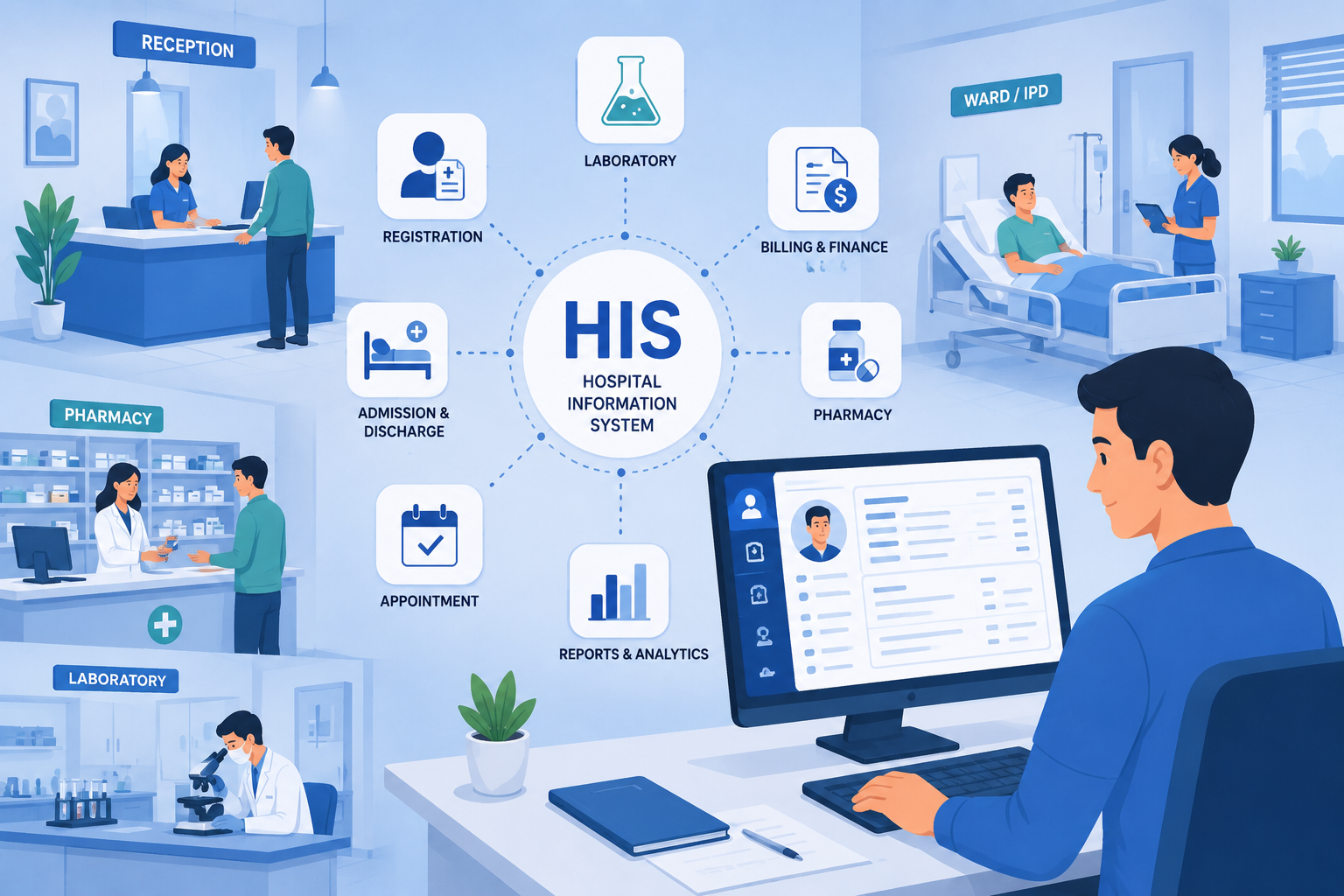
What Is a Hospital Information System (HIS)? Full Form, Modules and Benefits in India
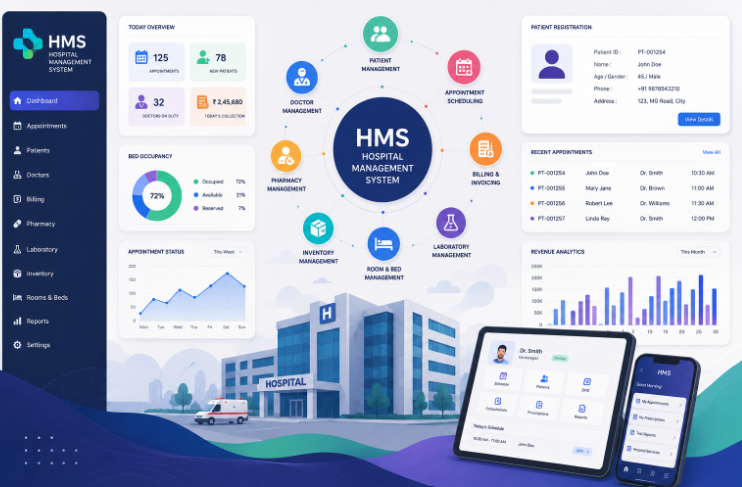
A Hospital Information System (HIS) is a software platform that manages a hospital’s patient records, appointments, lab work, pharmacy, billing and reports in one place. It replaces paper files and separate tools, so every department can see the same, up-to-date patient information.
HIS stands for Hospital Information System. In India, you will also hear it called a Hospital Management System (HMS) or HMIS. This guide explains what a HIS does, which modules it includes, how it works, how it connects to India’s ABDM program, and what to check before you buy one. A short general definition is also on Wikipedia.
What Is a Hospital Information System?
Think of a HIS as the digital backbone of a hospital. Every day, a hospital handles a huge amount of information: who the patient is, which doctor they saw, which tests were ordered, which medicines were given, and how much they need to pay.
Without a HIS, this information sits in different places. The front desk has one register. The lab has another. The pharmacy uses its own software, and billing uses a spreadsheet. Staff spend a lot of time asking each other for details, and mistakes are easy to make.
A HIS solves this by keeping everything in one connected system. When a patient is registered once, their details are available to the doctor, the lab, the pharmacy and the billing team. When a doctor orders a test, the lab sees it right away. When the test is done, the doctor sees the result on the same record.
HIS Full Form and Related Terms
People use several short names for hospital software, and they can be confusing.
| Term | Full form | What it means |
|---|---|---|
| HIS | Hospital Information System | The complete hospital system covering clinical, administrative and financial work |
| HMS | Hospital Management System | Another name for a HIS. Many vendors use HIS and HMS to mean the same thing |
| HMIS | Hospital Management Information System | The same idea, often used in government and public hospitals |
| EMR | Electronic Medical Record | The digital version of a patient’s chart inside one hospital or clinic |
| EHR | Electronic Health Record | A wider patient record that can be shared across different hospitals and providers |
The key point is that HIS, HMS and HMIS usually describe the same type of software. EMR and EHR are different. They are not separate products that compete with a HIS. They are parts of it. A good HIS includes an EMR module for doctors’ notes, prescriptions and patient history.
Core Modules of a Hospital Information System
A HIS is made of modules. Each module handles one area of hospital work, and all of them share the same patient data. Here are the main ones.
Patient registration and OPD
This module records patient details, books appointments, gives queue tokens and tracks who is waiting. Returning patients can be found in seconds. Doctors can write digital prescriptions, so there is no unclear handwriting to read.
IPD and bed management
When a patient is admitted, this module handles bed allotment, ward transfers, daily treatment notes and discharge. A live bed board shows which beds are free, so two patients are never given the same bed.
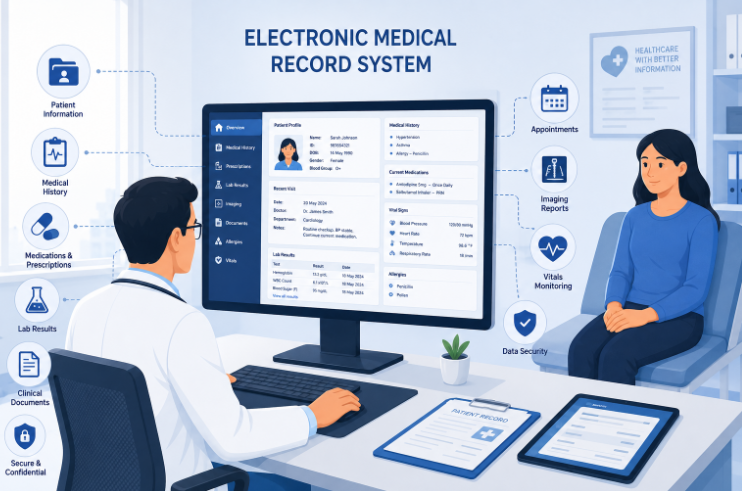
Electronic medical records (EMR)
This is where doctors save diagnoses, prescriptions, progress notes and discharge summaries. Any authorized staff member can open the full history of a patient when needed.
Laboratory (LIS)
The lab module receives test orders from doctors, tracks each sample, records results and prints reports. Abnormal values can be highlighted so doctors notice them faster.
Radiology (RIS)
This module manages scan and X-ray orders, schedules, reports and delivery of results. Some hospitals also connect it to PACS, a system that stores medical images.
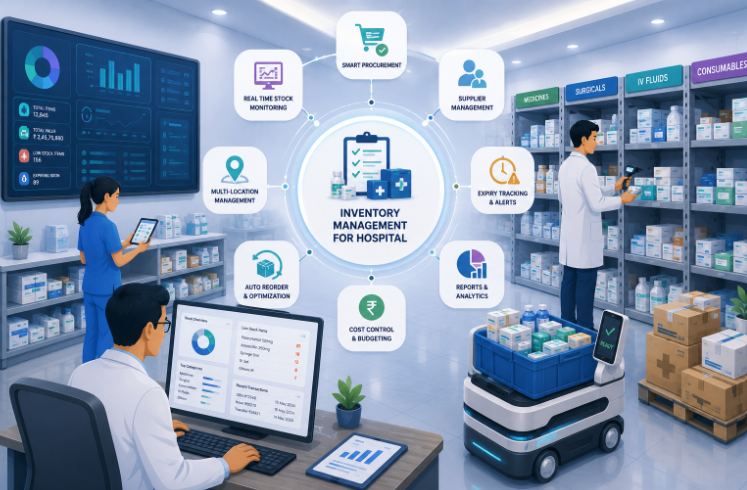
Pharmacy and inventory
The pharmacy module receives prescriptions, tracks stock, warns about medicines that are close to expiry and helps avoid running out of important items.
Operation theatre (OT)
This module plans surgery schedules, assigns surgeons and staff, and keeps a record of each case, so theatre time is used well.
Billing and insurance
Charges from every department flow into one bill. The system supports cash payments, insurance and TPA claims, and government schemes. It can also connect with POS machines for card and UPI payments. This helps reduce missed charges and billing errors.
Reports and dashboards
Managers can see daily patient numbers, bed occupancy, revenue and waiting times without collecting figures by hand.
How a HIS Works: One Patient’s Journey
The easiest way to understand a HIS is to follow one patient.
- Registration. Mrs. Sharma arrives with a fever. The front desk registers her once and gives her a token. Her details are saved in the system.
- Consultation. The doctor opens her record, checks her history and writes a digital prescription. The doctor also orders a blood test.
- Lab. The lab sees the order immediately. A sample is collected, tested and the result is entered. The doctor sees the report on screen.
- Admission. The doctor decides she needs to stay. The OPD record moves straight to admission, and a bed is allotted from the live bed board.
- Ward care. Nurses record vitals and medicines. Doctors see these updates without visiting the nursing station.
- Pharmacy. Medicines ordered for her are issued from the pharmacy, and the cost is added to her bill automatically.
- Discharge and billing. On the day she goes home, a discharge summary is prepared, charges from all departments are combined into one bill, and the bed is released for the next patient.
At no point did staff need to write her details again. That saves time and cuts the chance of errors.
Benefits of a Hospital Information System
HIS and ABDM in India
The Ayushman Bharat Digital Mission (ABDM) is the Government of India’s program to build a connected digital health system. Under it, each person can create an ABHA (Ayushman Bharat Health Account), a unique 14-digit health ID.
Here is why this matters for hospitals:
- ABHA creation at the front desk. A good HIS lets staff create or link a patient’s ABHA during registration.
- Linking records. Visits, prescriptions, lab reports and discharge summaries can be linked to the patient’s ABHA.
- Consent-based sharing. Health records are shared only when the patient gives consent. A hospital can act as a Health Information Provider (HIP), which shares records, or a Health Information User (HIU), which requests records with consent.
If you are choosing a HIS, ask the vendor which ABDM steps are completed and live, and ask to see them working. Do not rely on a claim alone. You can also check the official ABDM website and the National Health Authority for current rules.
Cloud vs On-Premise HIS
There are two main ways to run a HIS.
Cloud-based HIS. The software runs on secure servers managed by the vendor. You use it through the internet. The upfront cost is lower, updates are automatic, and you can check reports from anywhere. It is a good fit for small and mid-sized hospitals that do not have a large IT team.
On-premise HIS. The software runs on servers inside your hospital. You control the hardware and data directly, but you also need space, power, backup and an IT team to maintain it.
Neither choice is always better. Think about your budget, your internet reliability, your IT staff and how much control you want. Whichever you choose, ask about data backup, access control and what happens if the system goes down. Also ask how the vendor follows India’s Digital Personal Data Protection Act, 2023, which sets rules for handling personal data.
What Affects the Cost of a HIS?
Prices differ a lot between vendors, so it is hard to give one number. These are the factors that usually change the price:
- The number of beds and users
- The modules you choose
- Cloud or on-premise setup
- Setup, data migration and staff training
- Connections to lab machines, payment devices or insurance systems
- Support hours and ongoing updates
When you ask for a quote, find out what is included and what costs extra, such as training, new modules or extra branches.
How to Choose the Right HIS
Use this checklist when you compare options:
- List your needs first. Decide which departments must go live first and which can wait.
- Ask for a live demo. Use your own real situations, such as an OPD visit, an admission and a discharge bill.
- Check ease of use. Busy staff will not use software that is hard to learn. Ask how long training usually takes.
- Confirm the modules. Make sure the modules you need are included, not sold as extras.
- Review security. Look for role-based access, activity logs, encrypted data and regular backups.
- Ask about ABDM support. Check what is ready and working today.
- Plan the move. Ask how old patient records will be moved and how the vendor will help during the first weeks.
- Speak to a current customer. Choose one with a hospital of similar size if you can.
- Check support. Find out how quickly the vendor responds when something goes wrong.
- Think about growth. Make sure the system can add beds, departments or branches later.
A phased start often works best. Begin with the departments that cause the most daily problems, then add others as your team gets comfortable.
Frequently Asked Questions
What is the full form of HIS?
HIS stands for Hospital Information System.
Is a HIS the same as a Hospital Management System?
In most cases, yes. HIS, HMS and HMIS are different names for the same type of software that manages hospital work in one place.
What is the difference between HIS and EMR?
An EMR is the digital record of a patient’s medical history. A HIS is the full system that includes the EMR along with registration, billing, lab, pharmacy and other modules.
Can small hospitals and nursing homes use a HIS?
Yes. Smaller hospitals can start with basic modules such as registration and OPD, beds and billing, and add more later. Cloud-based systems have made this much easier and more affordable.
Is a HIS mandatory in India?
There is no single rule that forces every hospital to use one. However, accreditation such as NABH, government scheme participation such as PM-JAY, and ABDM involvement increasingly expect hospitals to use digital systems. Check the latest rules for your state and your goals.
Is patient data safe in a cloud HIS?
It can be, if the vendor uses strong access controls, encryption, activity logs and regular backups. Ask for these details before you decide, and see how iCAN Careflow handles security.
How long does it take to start using a HIS?
It depends on hospital size and how much data must be moved. Many hospitals start with a few key modules and expand step by step.
Bring Your Hospital Together with iCAN Careflow
A hospital runs best when every department works from the same information. iCAN Careflow is a cloud-based Hospital Management System that connects OPD, IPD, OT, ward management, lab, pharmacy and ABHA integration on one platform, so your teams spend less time on paperwork and more time with patients.
Book a free demo with iCAN Careflow today and see how it fits your wards, your doctors and your daily workflow.