INDIA
INDIA USA
USA
Best Hospital Management Software in India for Smarter Healthcare
Choosing the right technology partner can make or break how efficiently a hospital runs. With so many options available today, most hospital administrators find themselves searching for best hospital management software in India that can actually keep up with real-world clinical and administrative demands - not just look good in a sales demo. This guide walks through what to actually look for, the features that matter, and how to evaluate your options without getting lost in marketing claims.
What Is Hospital Management Software and Why It Matters
Hospital management software (HMS) is a digital system that brings together the administrative, clinical, and financial functions of a hospital into one platform. Instead of separate registers for patient registration, billing, pharmacy stock, and appointment scheduling, everything runs through a single connected system.
The real value isn't just digitization - it's coordination. When a patient's registration, doctor consultation, lab order, and billing are all linked, staff spend less time chasing information and more time on actual patient care. For hospitals still relying on spreadsheets or partial digital setups, this shift alone can noticeably cut down daily administrative friction.
Why Every Hospital in India Needs a Reliable HMS Today
Indian hospitals, whether in metro cities or smaller towns, are dealing with rising patient volumes, tighter compliance requirements, and increasing competition from newer, tech-enabled healthcare providers. A few pressures are pushing HMS adoption forward:
Hospitals that delay this shift often end up managing avoidable inefficiencies that directly affect both patient experience and revenue.
Core Features to Look For in a Hospital Management System
Not all HMS platforms offer the same depth. When shortlisting the best hospital management software in India, check whether it genuinely covers these core areas:
A platform that only handles one or two of these well isn't really a full hospital management system - it's a partial tool wearing that label.
Key Implementation Considerations Before You Switch
Buying software is the easy part; implementation is where most hospitals struggle. Before committing, consider how the transition will actually happen. Will existing patient records be migrated, or will staff be starting from scratch? How long is the typical onboarding period, and does the vendor provide hands-on training for non-technical staff?
It's also worth asking how much customization is possible. Every hospital's workflow is slightly different, and software that forces rigid processes onto an already-functioning department often creates resistance from staff rather than adoption.
Data Security and Compliance in Hospital Software
Hospitals handle some of the most sensitive personal data that exists - medical history, diagnoses, and financial details. Any HMS being considered should offer encrypted data storage, controlled user access, and detailed audit logs that track who accessed or modified patient records.
Compliance with data protection expectations isn't optional in healthcare. Before finalizing any vendor, hospitals should confirm how data backups are handled, what happens in case of a system failure, and whether the vendor has a clear policy on data ownership - since it's the hospital's data, not the vendor's, that's ultimately at stake.
Scalability: Choosing Software That Grows With You
A common mistake is choosing software based only on current needs. A 50-bed hospital today might expand to 150 beds in a few years, add new departments, or open a second branch. Software that can't scale smoothly often forces a costly, disruptive migration later.
Look for platforms built on flexible architecture that can handle added users, new departments, or multi-branch operations without requiring a complete system overhaul. This matters just as much for a growing single-location hospital as it does for larger multi-facility groups.
Integrations That Matter for a Connected Hospital
No hospital software works in isolation. A good HMS should be able to integrate with diagnostic lab equipment, pharmacy billing systems, insurance/TPA portals, and even SMS or WhatsApp-based patient communication tools. This is also where the line between a standalone billing tool and true hospital administration software becomes clear - the latter is built to connect every operational layer rather than function as a single-purpose add-on.
Before finalizing a system, ask directly what third-party integrations are supported out of the box, and which ones would require additional development work.
Cloud-Based vs On-Premise HMS: Which One Fits Your Hospital
Both models have valid use cases. Cloud-based HMS platforms typically require lower upfront investment, offer easier remote access, and receive updates automatically - making them a practical choice for many small and mid-sized hospitals.
On-premise systems, on the other hand, give hospitals more direct control over their servers and data storage, which some larger institutions prefer for internal policy or infrastructure reasons. The right choice usually comes down to budget, IT staff availability, and how much control the hospital wants over its own infrastructure versus convenience.
Choosing the Right Software Based on Hospital Size
Choosing software that matches your current scale - while still allowing room to grow - avoids both overpaying for unused features and outgrowing the system too soon.
How to Choose the Best Hospital Management Software in India
Before signing any contract, run through a simple evaluation process:
Vendors who are confident in their product usually don't hesitate to walk through these points directly rather than redirecting to generic brochures.
Where I Can Care Flow Fits In
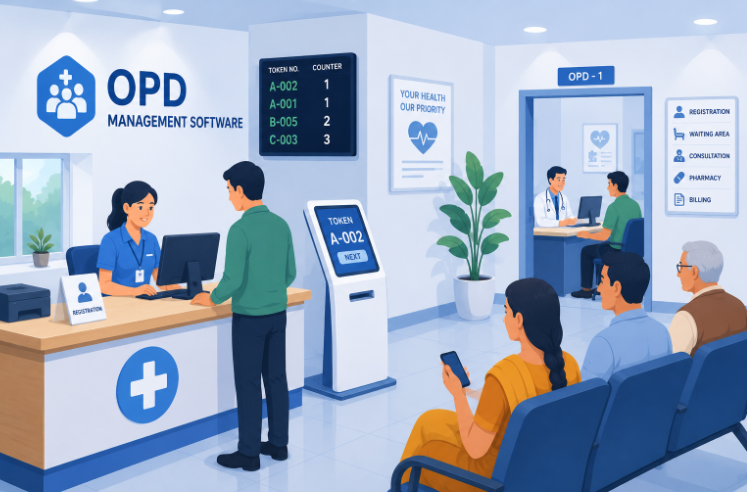
I Can Care Flow is built around the idea that hospital software should adapt to how hospitals already work, rather than forcing hospitals to adapt to rigid software. The platform covers core hospital operations - including OPD and IPD management, billing, pharmacy and inventory, and lab workflows - within a single connected system rather than as disconnected modules.
For hospitals evaluating options in India, I Can Care Flow focuses on straightforward onboarding, role-based access for staff, and integration support so that existing lab or billing tools don't need to be discarded immediately during a transition.
FAQs
What makes a hospital management software "the best" for a given hospital?
There's no single best hospital management software in India that fits every hospital - it depends on hospital size, current workflow gaps, and budget. The right fit is software that covers your core operational needs without forcing you to pay for unnecessary complexity.
How long does it typically take to implement a new HMS?
Implementation timelines vary based on hospital size and data migration needs, but most mid-sized hospitals can expect a phased rollout, starting with core modules like registration and billing before expanding to other departments.
Is cloud-based hospital software safe for sensitive patient data?
Yes, when the vendor follows proper encryption, access control, and backup protocols. Reputable cloud-based HMS providers often invest more heavily in security infrastructure than individual hospitals could manage independently.
Can small hospitals afford a full-featured hospital management system?
Many vendors, including cloud-based providers, now offer modular pricing, allowing smaller hospitals to start with essential features and add more as they grow, making full-featured systems more accessible than they used to be.
Related reading: What Is a Hospital Information System (HIS)? Full Form, Modules and Benefits
Conclusion
Finding the best hospital management software in India isn't about picking the platform with the longest feature list - it's about identifying software that genuinely fits your hospital's size, workflow, and growth plans, while keeping patient data secure and operations connected. Taking the time to evaluate implementation support, scalability, and integrations upfront saves hospitals from costly switching decisions down the line.
Ready to Simplify Hospital Operations With the Right Software?
I Can Care Flow brings OPD, IPD, billing, pharmacy, and lab management into one connected platform built for hospitals across India. See how it can work for your hospital.